
Is this tree sick or just stressed?
Tree Health Assessments in Akron, OH
What's wrong with the tree, how serious it is, and whether to treat, prune, remove or wait.
- No-cost estimates at your property in Akron and nearby towns
- Quotes in writing, broken out per tree
- We settle what leaves the property before we start
Answering the Question Before Anything Gets Cut
Tree health assessments are for the tree that doesn't look right: leaves browning in July, a crown thinning from the top down, bark falling off in patches, mushrooms at the base, or a beech with strange dark stripes on its leaves. Northeast Ohio has had more than its share of new tree problems in the last 20 years, and several of them are in Akron yards now. A careful look at the tree, the soil around it and its surroundings usually narrows down what's going on and what the realistic options are, so you aren't paying to remove a tree that could be saved, or paying to treat one that's already gone.
Oak wilt
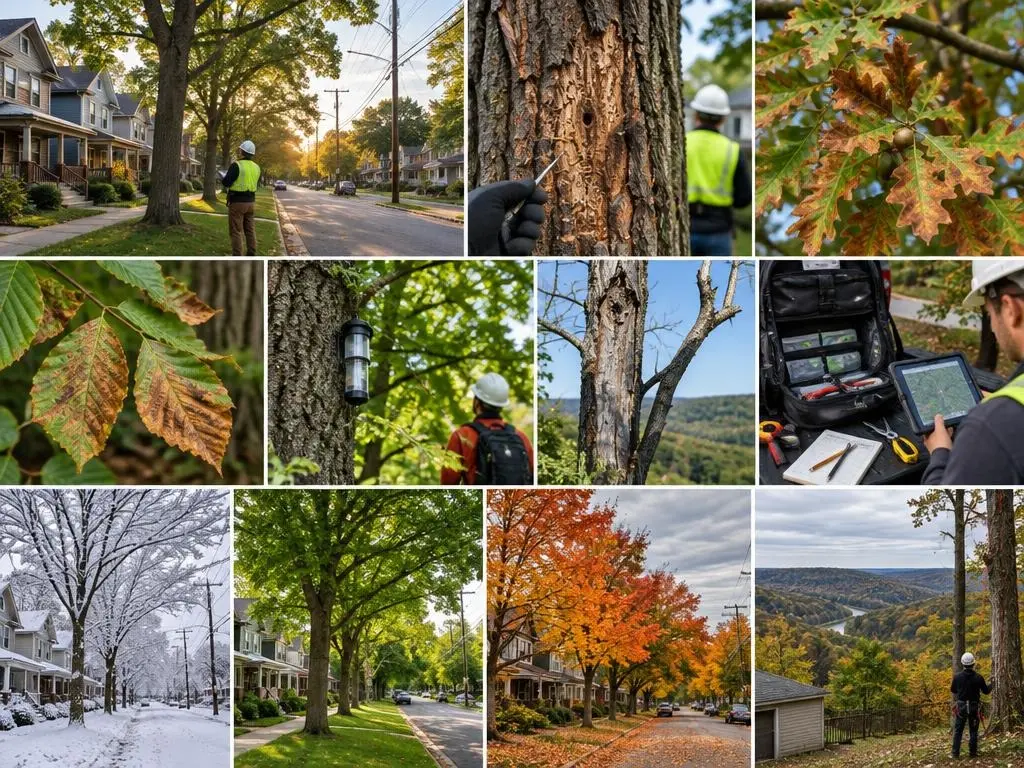
Oak wilt is a fungal disease that blocks the water-conducting vessels of oaks. Trees in the red oak group, such as northern red and pin oak, can die within a single season; leaves wilt and turn bronze from the top of the crown down, often in early summer. The City of Akron warned residents about oak wilt in 2017 after losses on the city's north and west sides. The fungus spreads through connected roots between nearby oaks and on beetles drawn to fresh wounds, which is why routine oak pruning belongs in late fall and winter.
Beech leaf disease
Beech leaf disease was first discovered in Lake County, Ohio, in 2012, and is caused by a microscopic nematode living in the leaves and buds. Ohio State University Extension lists the signs: dark bands between the leaf veins, best seen from below in spring; leaves that are crinkled, thick and leathery; aborted buds; and a canopy that thins over time. Symptoms have been documented in 25 Ohio counties, and trees of all ages have died within two to seven years. American and European beech are both affected, which matters in older Akron neighborhoods and wooded suburban lots where big beech are common.
Emerald ash borer and ash trees
Emerald ash borer was first identified in Ohio in 2003, and most untreated ash in Summit County have since died. Any ash that is still alive here has either been treated or has been lucky. Signs of attack include thinning at the top of the crown, woodpeckers flaking off the outer bark, D-shaped exit holes and S-shaped galleries under loose bark. Insecticide treatment can protect a healthy ash; once much of the crown is gone, removal is usually the better choice.
Spotted lanternfly
Ohio State University Extension in Summit County reports that spotted lanternflies have been seen in the county. The insect feeds on many plants but prefers tree-of-heaven, an invasive tree that's common along fences, alleys and vacant lots. If you see adults or their gray, mud-like egg masses, the Summit County Extension office (330-928-4769) can tell you how to report them.
Decay and structural risk
Not every problem is a pest. Cavities, fungal conks on the trunk or roots, cracks, a girdling root strangling the base, soil piled against the trunk, or construction damage to roots can all weaken a tree. An assessment looks at those and at the target: what the tree would hit if it, or a limb, failed. A tree with some decay out in the back of a wooded lot is a very different case from the same tree over a child's bedroom.
What an Assessment Looks At
We check the tree from the roots up and tell you what we find in plain language.
Crown and leaves
Thinning, dieback, leaf spots, banding, wilting and how much live canopy is left.
Trunk and bark
Cracks, cavities, exit holes, bark loss, cankers, seams and fungal growth.
Root flare and soil
Girdling roots, buried flares, mower damage, soil heave and signs of root rot.
Targets and risk
What sits within reach of the tree and how likely a failure is to hit it.
Options and timing
Treat, prune, cable, monitor or remove, with the reasoning and the best time of year.
Typical Assessment and Treatment Costs
| Service | Published range |
|---|---|
| Arborist inspection or consultation (HomeGuide) | $100 to $250 |
| Formal written arborist report (HomeGuide) | $150 to $450 per tree |
| Disease or insect injection (HomeGuide) | $75 to $250 per tree |
| Tree injection (HomeAdvisor) | $50 to $200 per tree, about $10 per inch of trunk |
| Deep root fertilization (HomeAdvisor) | $100 to $350 |
Ranges from HomeGuide (February 2026) and HomeAdvisor (June 2026). Our estimate visit is free; a formal written report or treatment program is priced separately and in writing. Your written estimate is the price.
How an Assessment Works
1. Tell us the history
When you noticed the problem, any construction, grading or storms, and what's changed.
2. Inspect
Crown, trunk, root flare and soil, plus what the tree could hit.
3. Explain the options
What we think is going on, how serious it is, and what each option means.
4. Written plan
If work is needed, a written quote that lists each step and its price.
Why Choose Us for Tree Health Assessments
Removal isn't the default
If a tree can be kept safely, we say so and explain how.
Local problems known
Oak wilt, beech leaf disease and ash borer are checked on every visit where those trees grow.
Plain answers
You get what we see and what it means, without jargon.
Tree Health Assessments Questions
How do I know if my oak has oak wilt?
Oak wilt in red oaks usually shows as leaves wilting and turning bronze or brown from the top of the crown downward, often in June or July, with leaves dropping while partly green. Other problems can look similar, so a closer look, and sometimes a lab test, is needed. Nearby oaks connected by roots are at risk too, which is why an early answer matters.
Can a tree with beech leaf disease be saved?
Researchers are still working on management, and no treatment is established as a cure. Ohio State University Extension reports that infected trees of all ages have died within two to seven years of symptoms, with smaller trees more affected. For a large beech near the house, the practical questions are how fast it's declining and when it becomes a risk.
Is it worth treating my ash tree?
If the tree is still healthy, with most of its canopy intact, insecticide treatment can protect it and must be repeated on a schedule. If a third or more of the crown is already dead, treatment rarely brings it back, and removal before the wood turns brittle is usually the safer path.
Where can I get a sample tested?
The Ohio State University Extension office for Summit County, at 440 Vernon Odom Blvd in Akron (330-928-4769), answers plant health questions and can point you to diagnostic services. ISA Certified Arborists can also take samples.
Tree Health Assessments Service Areas
- Tree Service in Akron, OH
- Tree Service in Cuyahoga Falls, OH
- Tree Service in Stow, OH
- Tree Service in Hudson, OH
- Tree Service in Kent, OH
- Tree Service in Fairlawn, OH
- Tree Service in Copley Township, OH
- Tree Service in Bath Township, OH
- Tree Service in Barberton, OH
- Tree Service in Norton, OH
- Tree Service in Tallmadge, OH
- Tree Service in Munroe Falls, OH
- Tree Service in Silver Lake, OH
- Tree Service in Green, OH
- Tree Service in Twinsburg, OH
- Tree Service in Macedonia, OH
- Tree Service in Wadsworth, OH
- Tree Service in Streetsboro, OH
- Tree Service in Aurora, OH
- Tree Service in Ravenna, OH
- Tree Service in Richfield, OH
- Tree Service in Peninsula, OH
- Tree Service in Coventry Township, OH
- Tree Service in Springfield Township, OH
Get a Tree Health Assessments Estimate
Free on-site estimates for trees that don't look right.